
Citroen e-C3 Van Review 2026
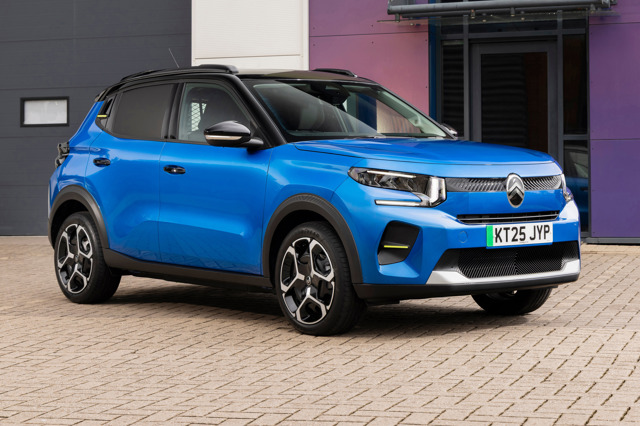

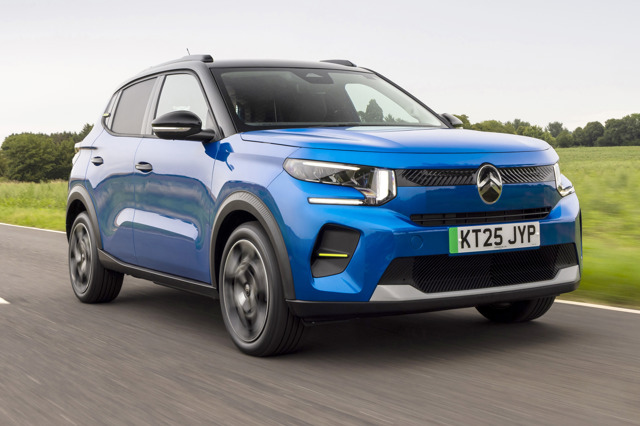
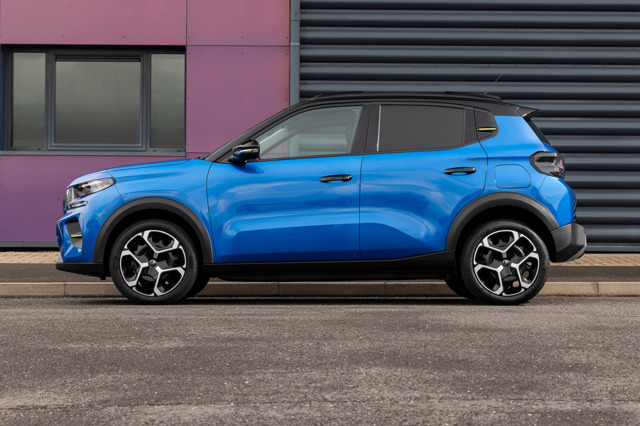
Citroen e-C3 Van At A Glance

 Fully electric, quiet and fun to drive, comfortable interior
 Limited driving range, some conversion quality niggles, small load bay
Car-derived vans are a simple concept — in this instance, take the battery-powered Citroen e-C3 car, remove its back seats install a more durable floor in the load bay, et voila, you've got the Citroen e-C3 Van.
These car-based commercial vehicles have made a big comeback in recent times, with models such as the Dacia Duster Cargo, the KGM Rexton Commercial and the Toyota Corolla Commercial all offering bespoke conversions which are ideal for van users who don’t necessarily need a large vehicle, but who want to capitalise on the tax advantages and ease of ownership offered by an LCV with low running costs.
The Citroen e-C3 Van is the latest addition to that booming car-derived van market, offering an eco-friendly solution for small business owners who mainly operate in urban environments. Its compact size and zero-emission, electric drive system make it ideal for city logistics, parcel deliveries, pharmacies and bakeries, to highlight but a few potential applications.
Like other electric vans, the Citroen e-C3 Van also meets the growing demand for sustainable transport and that's cost-effective.
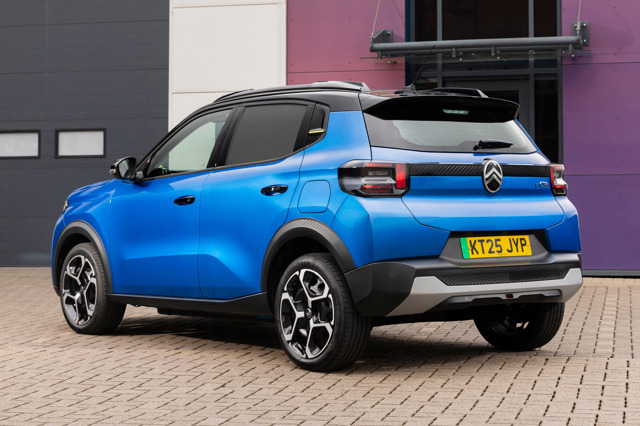
In order for it to be legally classified as a van, Citroen has had to make sure that it can’t be converted back into a car. It has done so by fitting a plywood loadspace floor, removing the rear seatbelts and their mounting points, blanking-off the windows in the back doors and fitting a mesh bulkhead behind the front seats.
It's crude in places, such as the way the rear window winders have been removed but their redundant mechanisms are left exposed, plus there’s also a complicated foldable parcel shelf.
Neither the smoothest or neatest of conversions, it does the job. Its non-slip floor features an additional six lashing points, while both rear doors and tailgate open as before for loading.
The Citroen e-C3 Van's energy is stored in a 44kWh lithium-ion battery, feeding an electric motor producing 113PS resulting in surprisingly sprightly acceleration in stop-start city traffic. The battery is mounted beneath the van, resulting a flat but fairly high load floor.
Officially, the Citroen e-C3 Van has a driving range of 201 miles according to the WLTP Combined cycle, but this will depend largely on factors such as temperature, driving style and load weights. Realistically, 150 miles is ambitious, so while it’s fine for urban use, longer distances aren’t its forte.
That said, it can be recharged at rates of up to 100kW when connected to a DC rapid charger, enabling a top-up from 20-80% in 26 minutes.
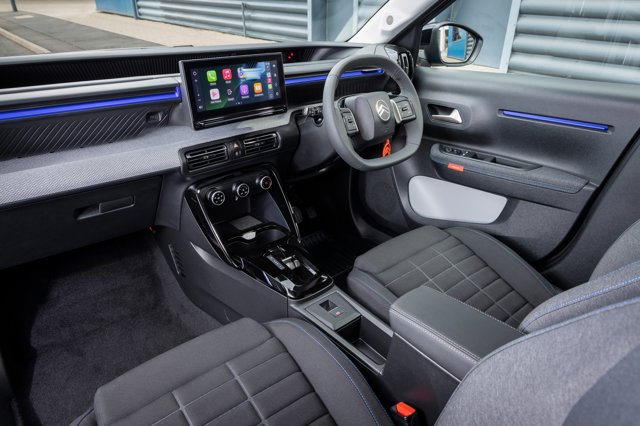
There’s just the one trim level called Plus, which has all the modern essentials including air conditioning and a 10.25-inch multimedia touchscreen display, which connects wirelessly to both Android Auto and Apple CarPlay.
Safety is as we’ve come to expect from Stellantis's products, so it’s equipped with a range of driver assistance features as standard including lane-departure warning, automatic emergency braking, traffic sign recognition and rear parking sensors.
In terms of warranty, Citroen offers a comprehensive three-year or 60,000-mile vehicle warranty, whichever comes first. The high-voltage battery is covered by an extended warranty of eight years or 100,000 miles.
It’s a van with a lot of character and plenty to recommend it for users whose needs it's designed to meet.
Driving the Citroen e-C3 Van
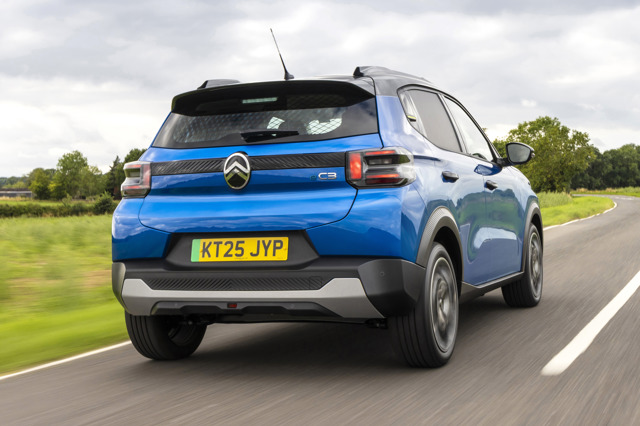
Thanks to the instant torque of its electric motor, the Citroen e-C3 Van provides accessible and surprisingly enjoyable performance for urban driving.
Its electric motor is exceptionally quiet, creating a relaxed atmosphere, and the low placement of the batteries keeps the centre of gravity down, improving its stability in corners. It’s fun to hustle along, although this will have a notable impact on your electric range, as well as delicate cargo you're carrying.
Also impressive were its lack of wind and tyre noise, making it far more refined than small vans typically are.
While it’s fine for most city journeys, frequent use and longer trips could prove frustrating due to the frequency you will need to plug it in. The key here it to be sure it will suit your needs before agreeing to buy one — if you're doubtful, then don't.
There’s only one level of regenerative braking so you can’t increase the power that’s fed back into the battery or drive with one pedal. That's a shame as driving in a city environment is where that approach works especially well.
Citroen e-C3 Van interior
For a small LCV, the Citroen e-C3 Van’s interior is surprisingly comfortable with the same extra-squishy seat cushions as the car version. Its on-board technology is sufficiently slick and easy to use.
As compact vans go, its cargo space is impressively usable and well laid-out, though you may want to remove the parcel shelf if you’re frequently using the entire load volume. As it's based on a small car, its overall capacity isn't massive at 1220 litres.
While the load space is durable, the e-C3 Van's plywood lower flooring tended to bump and rattle when being driving over rougher road surfaces.
The Citroen e-C3 Van's payload is competitive with other car-derived vans, but isn't the highest of the breed, with a maximum of 302kg. For its intended audience that should be fine, with few owners likely to get close to testing its limit.
Its cargo space's main dimensions are quoted at 1213mm for floor length, 1006mm in width and 935mm in height.
Overall the Citroen e-C3 Van offers several advantages, such as emission-free, near-silent driving, enabling hassle-free access urban clean air zones, with a decent payload and useful load space in the back.
It’s not perfect by any stretch of the imagination, but it has its place in the market and could well be a good choice for several small businesses — but ensure it meets your needs before signing on the dotted line.
