
Iveco unveils world’s first road-ready electric van with wireless charging

Thu, 05 Mar 2026
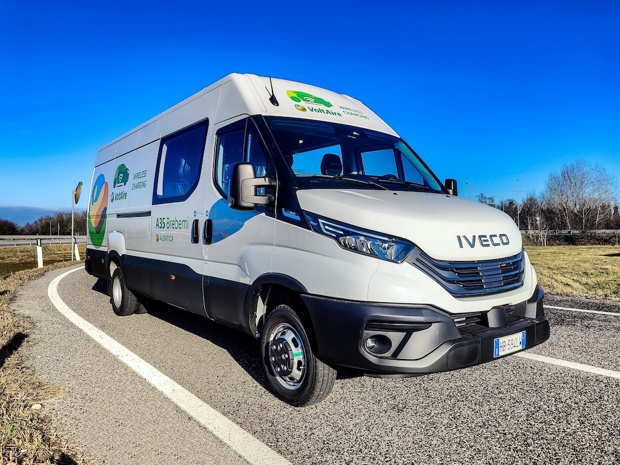
Iveco has developed an electric van equipped with wireless charging, which it says will revolutionise the use of large EVs.
The Iveco eDaily is equipped with integrated dynamic and static wireless charging and has gone into service with Italian motorway concessionaire Brebemi as the first road‑ready vehicle equipped for integrated wireless charging — both dynamic (DWPT – Dynamic Wireless Power Transfer) and static.
The six-seater crew van’s inductive charging system works in tandem with a dedicated infrastructure installed on the A35 motorway, which took over a year to integrate. The 1050m test circuit, located on a section of the A35, is designed to test the charging system and is powered by one megawatt of electrical power.
Marco Aimo-Boot, head of vehicle electrification, innovation and advanced engineering at Iveco Group, says the tests had shown highly positive results and that the company has “seized the opportunity” to prepare a new Iveco eDaily equipped with the DWPT system.
“Our ambitious goal is to extend static charging functionality to compatible public sites,” he adds.
Iveco said its decision to test a production‑ready vehicle equipped for wireless charging highlights how collaboration between infrastructure operators and manufacturers is becoming increasingly important.
