
Isuzu debuts new 2.2-litre diesel engine and right-hand-drive D-Max Electric

Thu, 23 Apr 2026
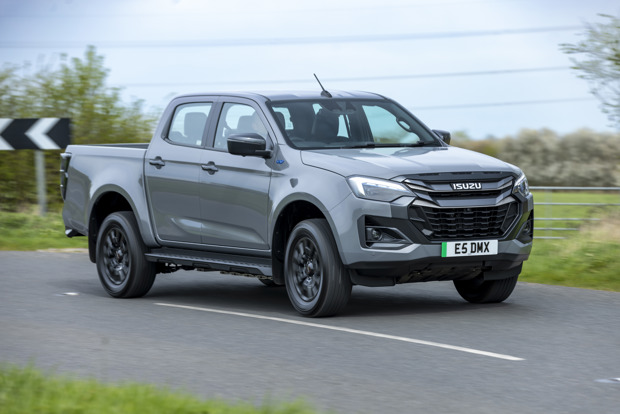
Isuzu has launched a new 2.2-litre diesel model and revealed the right-hand-drive Isuzu D-Max Electric at the 2026 CV Show.
The new Isuzu D-Max 2.2 Diesel uses a new engine to replace the existing 1.9-litre version, delivering improved efficiency along with a new eight-speed automatic alongside the six-speed manual option.
The Isuzu D-Max 2.2 delivers 163PS and 400Nm of torque, while a shift-on-the-fly four-wheel drive system allows switching between high gear two- and four-wheel drive at speeds of up to 62 mph. A low-gear four-wheel drive mode, coupled with rear differential lock and Rough Terrain Mode is standard across the range.
The range of cab options is made up of Single Cab, Extended Cab and Double Cab configurations. The entry-level Utility model is available in Single and Extended Cab, while the DL20 specification comes exclusively as a Double Cab.
The DL40 specification can now be ordered as an Extended Cab and Double Cab, while the top-of-the-range V-Cross is offered as a Double Cab.
Meanwhile, the New Isuzu D-Max Electric was also shown for the first time in right-hand-drive at the event, ahead of sales commencing in 2026.
The model is the first fully electric pick-up in the UK to provide over 1-tonne payload, 3.5-tonne towing capacity and permanent four-wheel drive. It is powered by a 66.9 kWh lithium-ion battery and dual motors located on the front and rear axles, producing a total output of 149.3 kW (45.9 kW front, 103.4 kW rear).
