
Mitsubishi L200 Review 2026
Mitsubishi L200 At A Glance
 Significantly improved on-road refinement over its predecessor. Impressive off-road ability. Roomier passenger cabin. 3.5-tonne towing ability. Good value for money.
 Over-zealous driver distraction warnings. Lack of a basic, entry-level version.
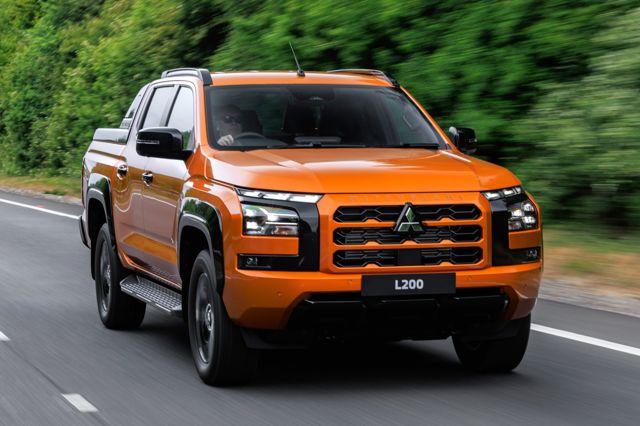
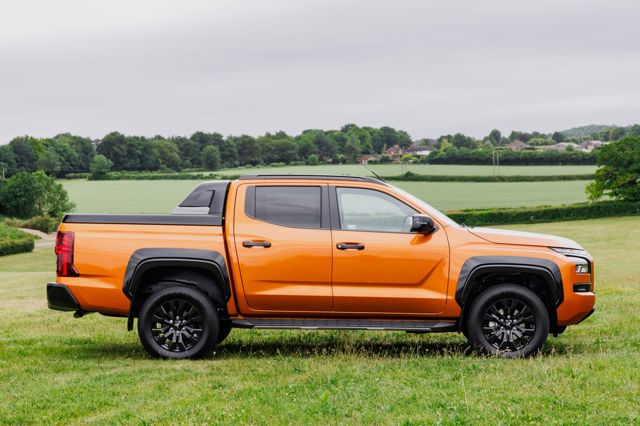
No, you’re not imagining things – the Mitsubishi L200 is back on sale in the UK. Now with machismo styling and significant improvements to how it drives in a concerted effort to dent the Ford Ranger’s pick-up market dominance. Read our full Mitsubishi L200 Series 7 review to find out whether it should be on your shortlist.
This latest generation of Mitsubishi L200 has arrived in British showrooms five years after the brand disappeared, making its return something of a surprise, albeit a welcome one for owners of the previous iterations.
Since the first L200 was launched in the 1970s, over 180,000 have sold in the UK making it the third best-selling pick-up in this market – and that’s despite its lack of availability since 2021.
Recent Mitsubishis sold in continental Europe have largely consisted of lightly restyled Renault cars, but the brand’s UK market resurrection comprises revitalised versions of two of its own heartland models. As well as the L200 Series 7 dealers will also be selling a fresh take on the Mitsubishi Outlander PHEV SUV.
Although it’s new here, the L200 Series 7 was launched in its Thai home market back in 2023, so don’t be surprised if it receives a mid-life facelift within a couple of years. Its mechanicals and chassis are substantially different from those of the Mitsubishi L200 Series 6 sold between 2019-2021, with improved efficiency and refinement from its 2.4-litre twin-turbo diesel engine.
As Mitsubishi’s previous UK operation closed in 2021, imports of the L200 are handled by International Motors Ltd. Its portfolio includes cars from Subaru and XPeng, but interestingly it’s also responsible for bringing two of the Mitsubish’s pick-up rivals to British buyers in the guises of the GWM POER300 and the Isuzu D-Max.
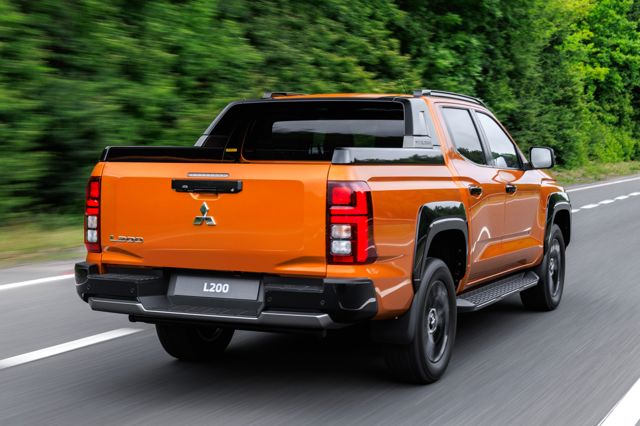
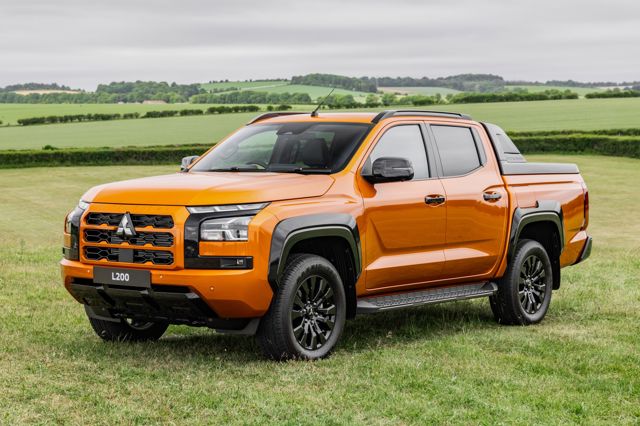
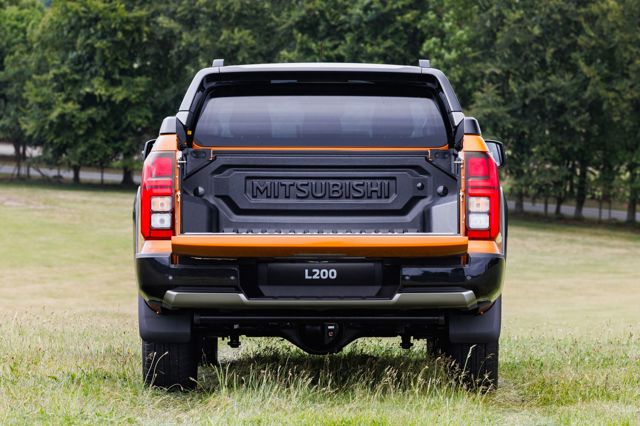
Two specifications of Mitsubishi L200 are available from the outset. Titan is the more workaday variant, ensuring the likes of the KGM Musso is among its rivals, although it isn’t a stripped-out, basic specification. Hallmarked by its body-coloured grille and black wheelarch extensions, roof rails and load bed surround, Barbarian is likely to appeal more to Ranger and Toyota Hilux buyers.
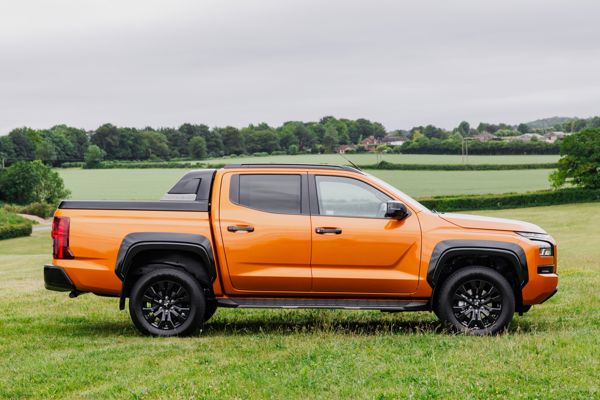
A six-speed automatic transmission and part-time all-wheel drive systems are fitted to both trim levels, with L200 Barbarians benefiting from Mitsubishi’s more sophisticated Super Select II 4WD package incorporating seven driving modes.
Mitsubishi’s pick-ups have long been favoured by customers who value the L200’s go-anyway off-roading agility and workhorse-like toughness, qualities which also feature in the forthcoming L200 Commercial Series 7, aimed at construction professionals, farmers and tradespeople.
It retains the double-cab bodywork but has been modified to ensure its compliance with commercial vehicle legislation so that operators can take advantage of a flat £4020 Benefit-in-Kind (BiK) rate and a 100% plant and machinery allowance. Those modifications include replacing the rear bench with a secure, hidden load compartment and a bulkhead behind the two remaining front seats, accessed via the back doors.
Just like the Ranger, the Mitsubishi L200 Series 7 will haul along up to 3500kg of braked trailer, but it just falls short of its Ford rival with an overall payload high of 1092kg in Titan specification compared with the Ranger’s 1098kg maximum.
Prices for the Mitsubishi L200 Series 7, exclusive of VAT, start at £36,295 for the Titan rising to £41,195 for the two-seater Commercial Barbarian, complete with a five-year warranty and pan-European breakdown cover for the same period. By contrast, the least-expensive Ford Ranger double-cab, albeit with a 3.0-litre V6 diesel engine and a 10-speed automatic gearbox starts at £37,606 (excluding VAT).
Within the International Motors family, the GWM POER300 is available from £32,495, while the Isuzu D-Max double-cab costs upwards of £37,645, both prices exclusive of VAT.
Driving the Mitsubishi L200
Whichever version of the Mitsubishi L200 Series 7 you choose, there’s only one engine available. It’s a 2.4-litre, four-cylinder diesel with a pair of turbochargers producing 204PS and 470Nm of torque. Useful increases in grunt over the Isuzu D-Max, similar outputs to the GMW POER300, but shy of the Ford Ranger.
Compared with the previous L200 Series 6’s engine, the latest motor is far more refined and civilised, with much reduced levels of mechanical vibration felt through the Mitsubishi’s structure. It’s audible, naturally more so as speed increases, but not aggravatingly so – in-cab conversations at the national speed limit need only be at normal volume.
While pick-ups are rarely bought for their performance credentials, the L200 Series 7 accelerates from a standstill to 62mph in 12.6 seconds and on to a top speed of 111mph. Of greater use is knowing that it gathers pace swiftly, which is especially useful should you need to overtake slower vehicles on single-carriageway roads or building up momentum when joining motorway traffic, with a linear introduction of power due to the way the turbochargers are introduced, rather than a sudden surge of alacrity as they spool up.
That wealth of torque comes into its own when towing heavy loads, such as the 3.2-tonne combination of a three-axle trailer with another L200 lashed to it we tested at the Mitsubishi’s launch. Describing its ability to haul the load as ‘effortless’ barely does it justice – if the L200’s trio of rear-view mirrors had been covered, you would be hard-pressed to know anything at all was hitched to the back.
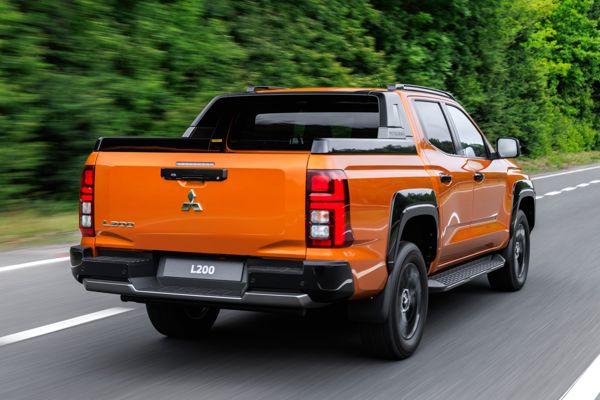
Unlike its predecessor, this generation of the L200 does without a manual gearbox, with a six-speed automatic being the sole transmission. This isn’t a retrograde step given how smoothly it self-changes and, despite being four ratios short of the Ford Ranger’s transmission, it neither dithers between gears or holds onto a lower one for too long.
Despite Mitsubishi’s years of experience producing plug-in hybrid (PHEV) petrol-electric drive systems, there’s no sign of such a mechanical arrangement being fitted to the L200 anytime soon, allowing the Ranger PHEV to maintain control of that aspect of the pick-up market. Similarly, there’s no fully electric L200 on the horizon, either, allowing the battery-powered Isuzu D-Max and Toyota Hilux to make the most of the customers currently considering such a vehicle.
As per the template laid down by previous iterations of the L200, the latest Mitsubishi pick-up features part-time all-wheel drive, as do the D-Max and Hilux, rather than a permanent system featured with the Ranger. The main benefit is to reduce fuel consumption when the L200 Series 7 only requires its rear wheels to be driven – which will be the majority of the time.
According to the WLTP Combined cycle, average fuel consumption for the L200 Series 7 is 33.3mpg – on test we averaged an indicated 35.7mpg on a route which encompassed road speeds of 30mph to 60mph in heavy rain.
Ford’s equivalent official test figures for the Ranger diesel are 26.7-27.7mpg, GWM claims 32.7mpg for the POER300 and Isuzu 31.4-32.5mpg for its D-Max
Mitsubishi L200: Off-road driving
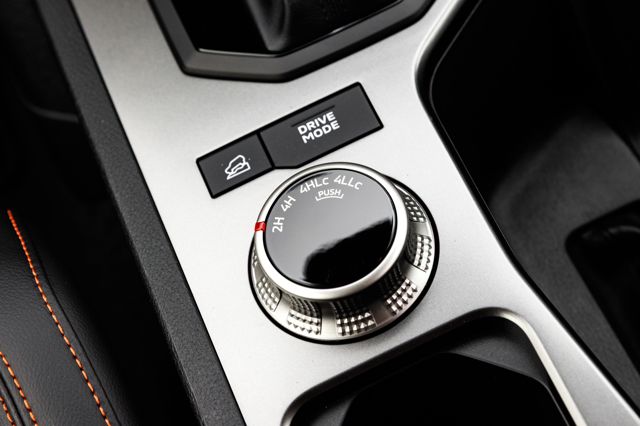
Which specification you choose will determine which system is fitted. L200 Titan models are labelled Easy Select, which is intended to be used on-road in rear-wheel drive only (2H), with high- (4H) and low-range (4L) all-wheel drive – selectable via a rotary knob on the centre console – intended for off-road use only.
There’s a more sophisticated, but as easily operated, Super Select II system fitted to L200 Barbarian derivatives which additionally features high-range all-wheel drive with both an open (4H) and locked (4HLc) centre differential. The former’s intended for on-road use, such as when towing heavy loads, the latter for when surfaces are loose or slippery. Switching between than can be performed at speeds of up to 62mph.
We also put the Mitsubishi L200 through its paces at Thruxton’s challenging off-road driving course, taking advantage of its all-wheel drive system in low-range with the centre differential locked (4LLc) and Hill-Descent Control – think of that as a low-speed off-road cruise control. Unlike the other transmission selections, 4LLc can only be engaged when the pick-up is stationary, in neutral and with the brakes applied.
It proved remarkably agile and controllable, even though it was still shod with road-biased tyres. Like all similarly sized pick-ups, the load bed creates a long rear overhang, which ultimately impairs the L200’s ability to mimic a mountain goat’s agility – or that of a Land Rover Defender 90 Hard Top, for that matter.
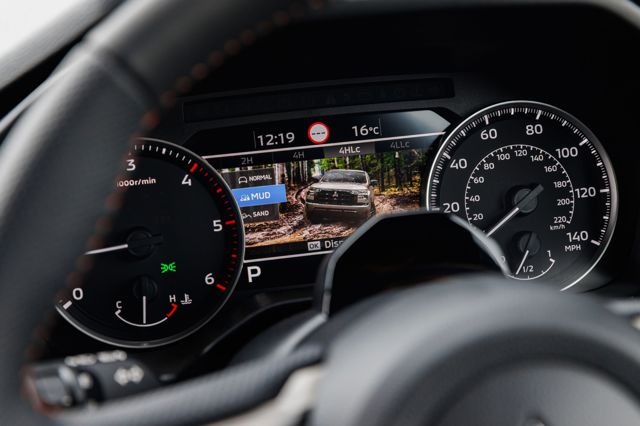
L200 Barbarians with Super Select II also have seven terrain driving modes to select between. Normal is the default for each of the four driven wheels settings, while the others are restricted. Eco is only operational in 2H; 4H enables Gravel and Snow to be chosen; Mud and Sand can be selected in 4HLc; Rock – for hard-core off-roading – is only engaged with 4LLc.
Mitsubishi L200: Handling and comfort
On-road handling and ride comfort were far from strengths of earlier generations of L200, a fact that’s been amplified by how impressive the Ford Ranger is in both regards, even without going to the expense of the flagship Raptor model with its trick suspension components.
Pleasingly, Mitsubishi has worked hard to improve these traits with the latest L200 Series 7, a feat all the more impressive when one remembers this is a pick-up with a separate chassis, which promotes flexibility throughout the vehicle structure – despite being 40% stiffer than its predecessor – as well as relatively unsophisticated leaf spring suspension for the rear wheels. In fact, the latest L200 is so much better than its most immediate forebear as to feel two generations newer, not just one.
It isn’t quite as well-controlled as the Ford, but the minimal levels of body lean when cornering or fore and aft rocking under heavy braking or acceleration are accomplished. Over undulating roadscapes, such as those experienced on test in rural Hampshire, the Mitsubishi faithfully follows the topography without undue floatiness or thumping down on its suspension bump stops.
Note that our test was conducted with an empty load bed – those rear springs have to cope with potential loads weighing over a tonne squashing them flatter as well as keeping the handling in check.
Ride comfort over rough asphalt surfaces is well-judged and absorbent, while on smoother finishes there’s slightly more audible tyre noise generated by the chunkier tread blocks. There’s little variation between how it performs in these regards at different speeds.
There’s little feel of what’s going on traction-wise communicated through the steering wheel to the driver’s hands, a side-effect of its chassis-type and off-roading credentials, but you soon learn to have faith in its ability to go where you expect it to around corners providing you keep speeds sensible. It’s light enough to twiddle left and right without giving you forearms like Popeye’s, without feeling so assisted as to be disconcerting. For reference the L200’s turning circle is 12.4m.
Braking performance was more than sufficient to bring the L200 Series 7 down to a complete standstill from higher speeds, without feeling remotely wayward, although again this was with an empty load bed. There’s a reassuring sensation of resistance through the brake pedal, making it easy to modulate as you scrub off pace thanks to its linear action.
Mitsubishi has equipped the L200 with a full suite of Advanced Driver Assistance Systems (ADAS) including features such as lane-keeping assistance. A single button on the steering wheels accesses a menu to switch off features you don’t like.
Of them the driver attention monitor proved the most aggravating, chiming away far too readily, including when checking the rear-view mirrors or glancing at the navigation mapping. Conversely, the adaptive cruise control worked faultlessly, including at urban speeds, bringing the L200 to a complete standstill when vehicles ahead were stationary.
Mitsubishi L200 interior
If maximising the Mitsubishi L200 Series 7’s payload capacity is of key importance to you, then opt for the Titan specification with a maximum of 1092kg. With its extra equipment and bodywork addenda factored in, the pricier L200 Barbarian’s best is notably lower at 1025kg.
Diesel-engined Ford Rangers can manage payloads of 1054-1098kg depending on trim level, while the Isuzu D-Max is rated for 1085-1105kg.
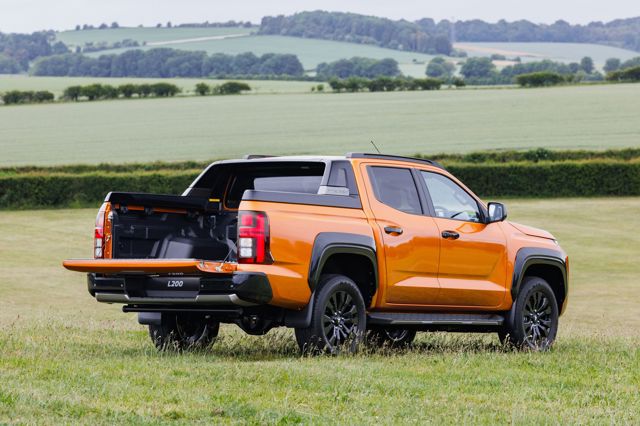
Dimensions-wise, the Mitsubishi’s load bed is 1555mm long, 1545mm wide and 526mm deep. Ford doesn’t quote the Ranger’s maximum load bed width, but it’s 1638mm long and 529mm deep. Isuzu’s D-Max has measurements of 1520mm, 1530mm and 500mm respectively.
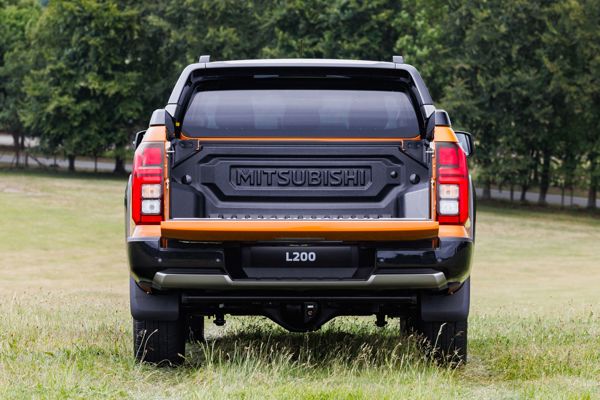
You can choose all manner of finishes for the load bed, including plastic and carpeted liners, while canopy tops and roller covers can also be specified at extra cost.
Barbarian versions of the L200 have additional bodywork surrounding the load bed, rising up to create a cowl around the rear windscreen. Their purpose is purely decorative rather than for any aerodynamic efficiency, but their presence means there’s extra height to lift items over when accessing the load bed from the sides. The structure is relatively easy to unbolt and remove, though.
Mitsubishi L200: Cab space
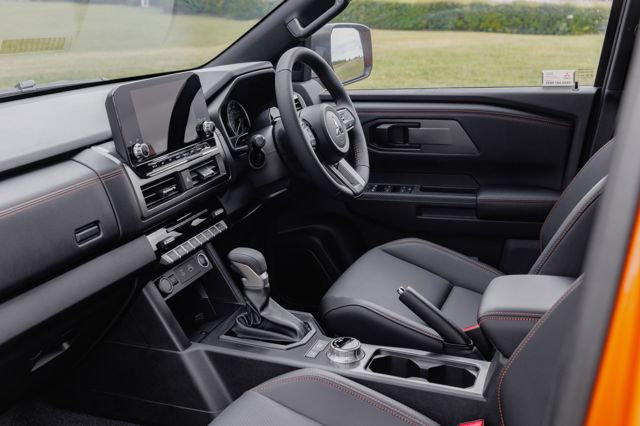
Front seat space and comfort is comparable with a large SUV, although climbing aboard may prove a stretch for people with mobility issues, given the height of the L200’s seat bases from the ground, but there are additional grab handles on the pillars by all four doors. Similarly, getting out again involves stepping down to ground level.
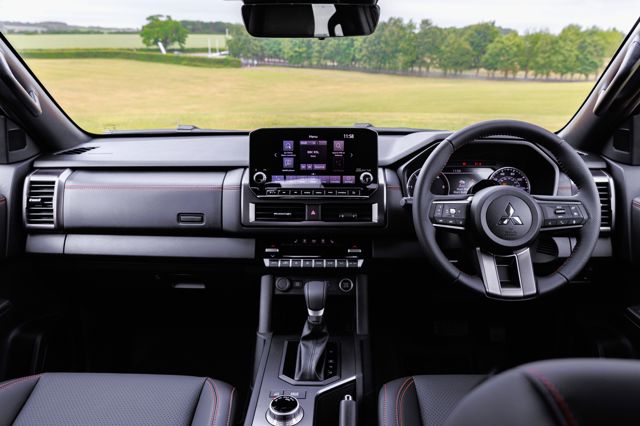
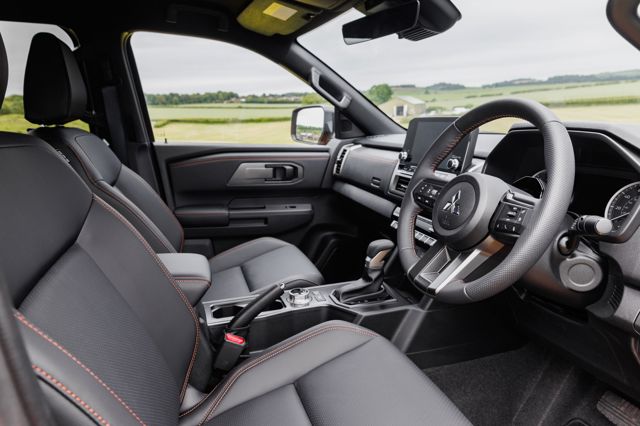
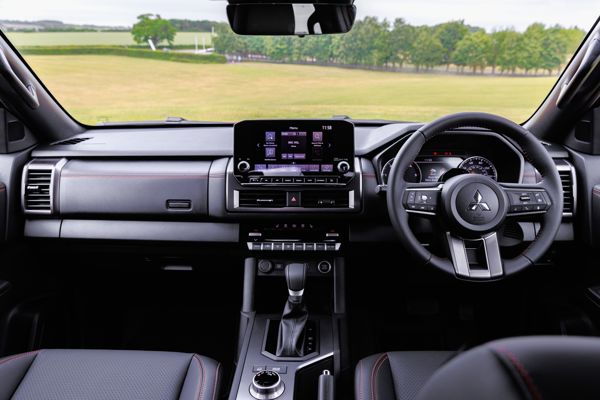
While superficially the Mitsubishi’s dashboard and controls look generically similar to those of a multitude of SUVs, the quality of the plastics betrays the L200’s role as a commercial vehicle. They’re harder to the touch, but that makes them usefully resilient. Quite why there are liberal applications of a faux carbonfibre decoration to various plastics is less clear.
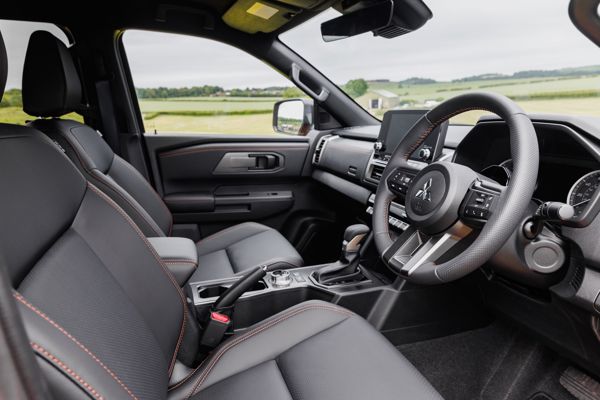
Ahead of the driver is a colour screen flanked by two analogue dials, something of a rarity in any kind of vehicle nowadays, while protruding vertically from the centre of the dashboard is a 9.0-inch multimedia touchscreen, itself with two rotary knobs in its lower corners.
It’s satisfactorily responsive, with clear graphics and intuitive menus, although we suspect for the most part L200 Series 7 owners will simply use the standard Android Auto and Apple CarPlay smartphone mirroring functions.
Usefully, not all of the Mitsubishi’s functions have been migrated to the touchscreen, so you can still adjust settings such as the climate control temperature using physical buttons. Storage space inside is fine, with a cubby below the front centre armrest, two cupholders moulded into the surround behind the gear lever, plus door pockets and a glovebox. Titans have an open shelf above the glovebox, while on Barbarians that space is also lidded.
Although all L200 Series 7s sold in the UK have the double-cab body, what you find when you open the rear doors depends on whether you have spent an extra £1200 (excluding VAT) on a Commercial version. They have had their rear bench seat, seat belts and other fittings removed, replaced with a covered storage facility with extra open space above.
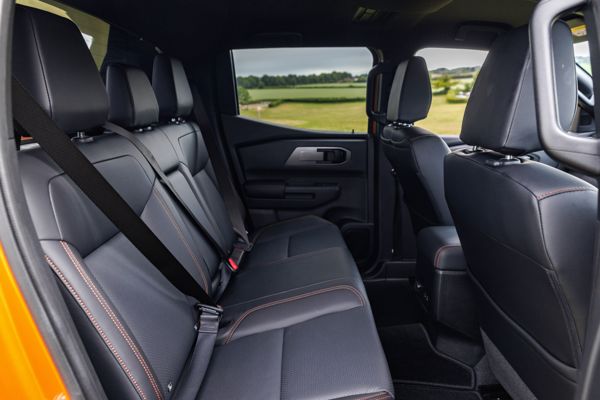
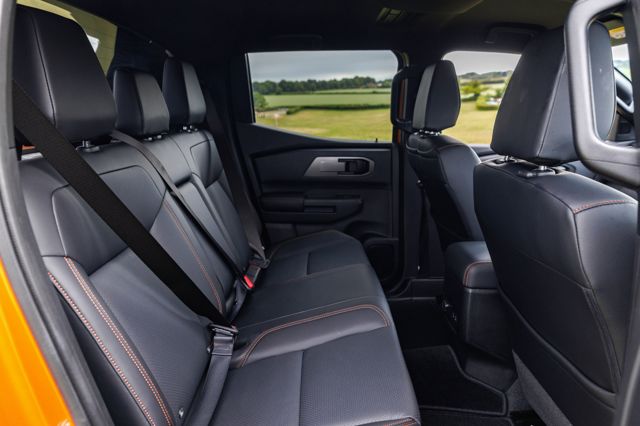
Mitsubishi expects the regular five-seater L200 to be the more popular variant. Space and comfort on the outer rear bench positions are commendable, yet the centre passenger, despite having a generous amount of width between the buckles, has to contend with a less supportive cushion and seatback. Both are convex in shape, whereas the outer seats are concave and scalloped out.
There’s significantly more cabin space front and rear than in the Series 6 L200, with only the Ford Ranger and its VW Amarok twin outranking it for capaciousness. Our six-foot tall tester was able to comfortably sit in the back behind his own driving position, with plenty of clearance for his legs.
In-cab refinement has massively improved compared with the previous-generation Mitsubishi L200. The Series 7’s sound-deadening materials permit less engine and gearbox noise to enter the cabin, with wind noise and tyre roar are relatively subdued, particularly when one considers the L200’s perpendicular shape and the vast door mirror housings.
Mitsubishi L200: Equipment
Both the five-seater and two-seater Commercial versions of the Mitsubishi L200 Series 7 are available in entry-level Titan and range-topping Barbarian specifications.
Standard features of the L200 Titan include 17-inch alloy wheels, side steps, rear parking sensors, a reversing camera, single-zone climate control, Android Auto and Apple CarPlay and vinyl flooring. Excluding VAT prices are £36,295 and £37,495 for the Commercial version.
Additional equipment specific to the L200 Barbarian includes 18-inch alloy wheels, LED headlights, keyless entry, black body styling additions, faux leather seat upholstery, heated front seats, an electrically adjustable driver’s seat, in-cab carpeting and dual-zone climate control. Prices, exclusive of VAT, are £39,995 and £41,195 for the two-seater Commercial option.
All L200s come with a five-year/62,500-mile warranty, but for an additional £450 the distance element can be increased to 125,000 miles.
Mitsubishi L200: Should you buy one?
Thanks to its elevated levels of refinement, improved handling and comfort, payload carrying and towing abilities, not least its value for money as an overall package, the Mitsubishi L200 Series 7 warrants a place on your pick-up shortlist.
Overall, it’s not polished enough to topple the Ford Ranger as being the best of those currently available, although the gap between them isn’t significant. For owners of older L200s, expect to find the latest Mitsubishi to be far more accomplished – if not as workaday – than what you have been used to.
Don’t be surprised to see the latest Mitsubishi L200 become a regular sight on the nation’s roads – and in its fields – very quickly.
